 Check Your Eligibility
Detailed Corneal Evaluation
Careful assessment of the cornea to understand its shape, thickness and condition.

Keratoconus causes the cornea to gradually thin and change shape, leading to distorted or blurred vision. Early evaluation and appropriate management can help monitor its progression and protect visual quality.
Medically reviewed by Dr. Amit N. Solanki, MBBS, DOMS, DNB, FAECS
Keratoconus is a progressive condition in which the normally round cornea becomes thinner and gradually bulges into an irregular cone-like shape.
The cornea is the transparent front surface of the eye and plays an important role in focusing light. When its shape becomes irregular, light fails to focus sharply on the retina, resulting in distorted and blurred vision.
The condition often begins during teenage or early adult years. Corneal cross-linking may help slow or halt progression in suitable cases, while spectacles or specialised contact lenses may help improve visual clarity.

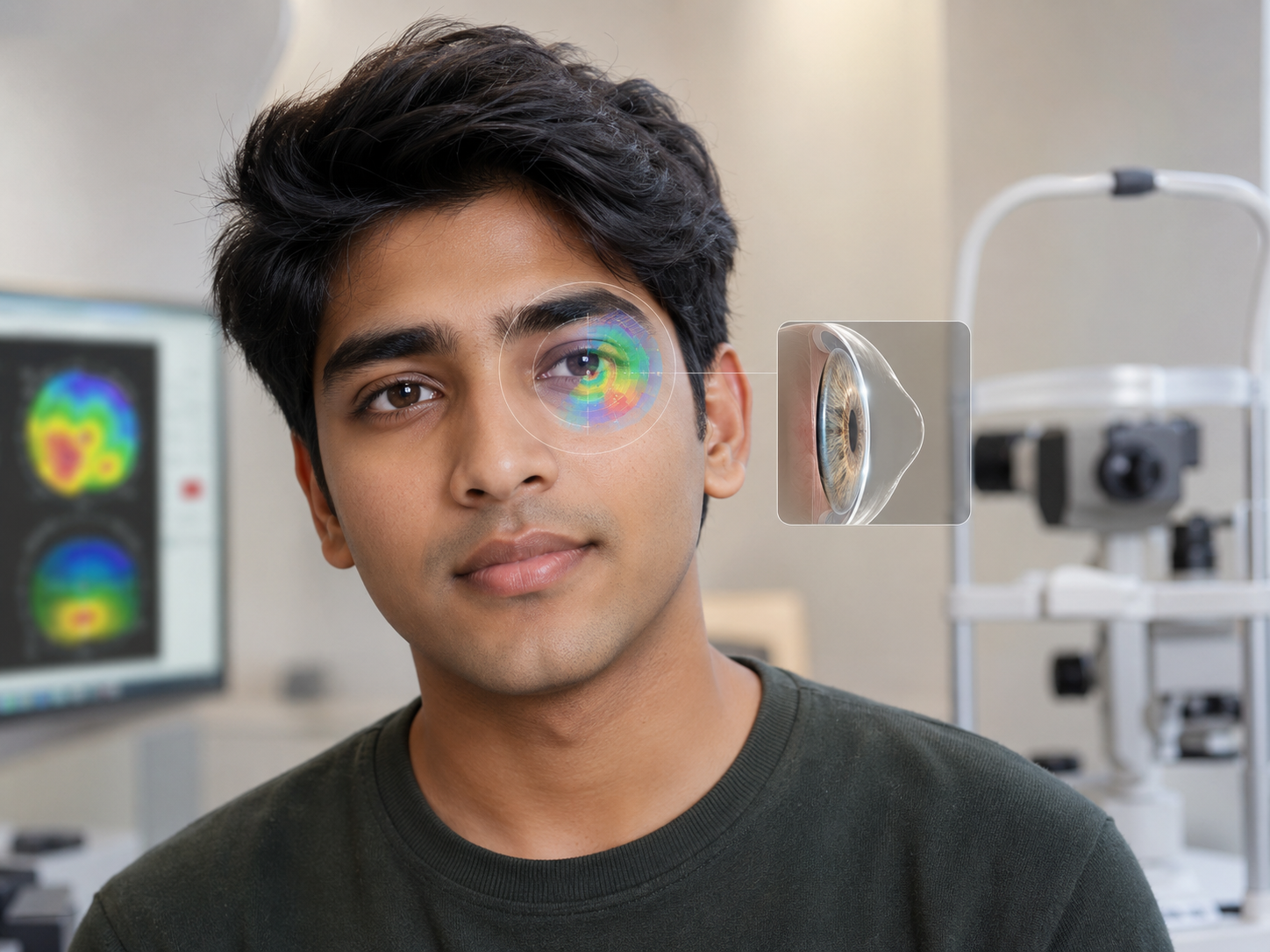
Detailed corneal evaluation and advanced monitoring to protect visual quality.
Careful assessment of the cornea to understand its shape, thickness and condition.
Regular evaluation can help identify changes and monitor whether keratoconus is progressing.
Diagnostic assessment using corneal mapping and other investigations when clinically required.
Care recommendations based on the stage of keratoconus, visual needs and progression.
Guidance on suitable glasses or contact-lens options depending on the condition.
Corneal cross-linking may be considered in appropriate patients to help slow or halt progression.





Treatment depends on the severity of the condition, quality of vision and whether the keratoconus is progressing.

In earlier stages, spectacles or specialised contact lenses may help improve visual clarity by correcting the refractive error caused by the irregular cornea.
Book Consultation
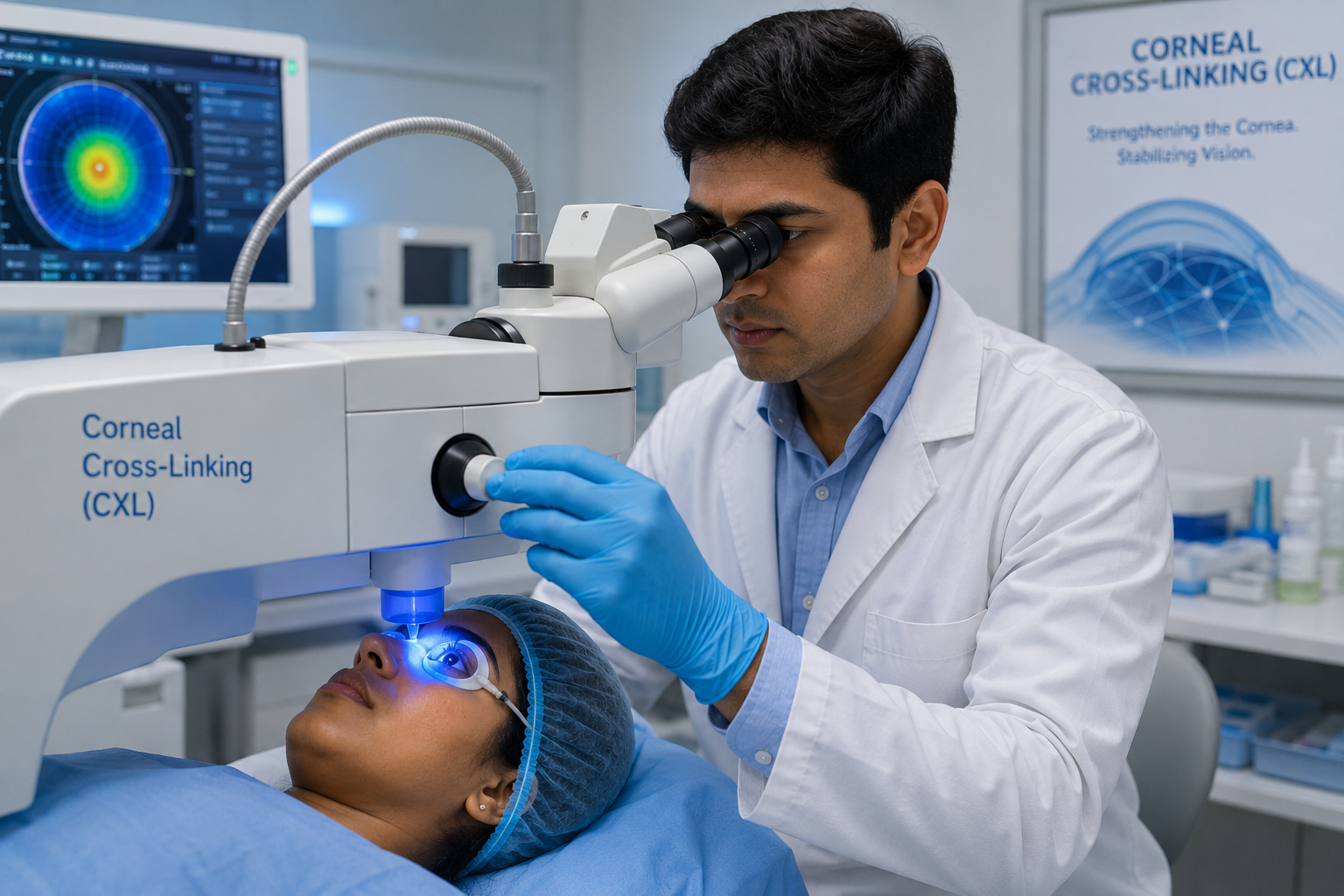
Cross-linking is used in appropriate cases of progressive keratoconus to strengthen the corneal tissue and help reduce further progression.
Book Consultation
Intacs Inserts thin, semi-circular implants placed within the cornea to help flatten its shape and improve vision in selected cases.
Book ConsultationDetect progression early and preserve clear, functional vision.

Regular corneal evaluation can help identify changes before significant progression occurs.

Appropriate correction and management can help patients maintain better usable vision.

In suitable progressive cases, cross-linking can help stabilise the cornea and reduce further deterioration.
What Our Patients Say About Shanti EyeTech

"Our family recently had the opportunity to take laser and cataract surgery services at Shanti Eye Tech Hospital, and it was truly an amazing experience from start to finish. Dr. Amit Solanki and his dedicated staff went above and beyond in taking care of us. It's rare to find a place where advanced medical care meets such heartfelt compassion."
"Dr. Solanki explained everything clearly, which gave us a lot of confidence and comfort. The surgery was successful, and the post-operative care was also very attentive. His professionalism, calm nature, and expertise truly stand out."
"I had a very good experience at Shanti Eye Tech Clinic. Dr. Amit Solanki is extremely knowledgeable, patient, and attentive. He listened carefully to my concerns and explained the condition and treatment clearly, which made me feel very comfortable and confident."
Our eye-care team can help you understand keratoconus evaluation, monitoring and treatment options.
The exact cause is not always known. Genetic and environmental factors may contribute, and keratoconus can sometimes run in families.
Not necessarily. Progression varies between individuals. This is why periodic corneal evaluation and comparison of measurements are important.
Glasses may provide adequate vision in early keratoconus. As corneal irregularity increases, specialised contact lenses may provide better visual correction for some patients.
Corneal cross-linking is a procedure designed to strengthen corneal tissue. It is primarily intended to reduce or stop further progression rather than simply remove spectacle power.
Keratoconus generally makes standard corneal laser vision-correction procedures such as LASIK unsuitable. A detailed corneal assessment is necessary before considering any refractive procedure.
Yes. Keratoconus commonly affects both eyes, although its severity and progression may differ between them.
Detecting keratoconus early allows the ophthalmologist to monitor progression and consider treatment before more significant corneal changes occur.
If you are experiencing frequent power changes, distorted vision or have been diagnosed with keratoconus, a detailed corneal evaluation can help determine its current stage and the appropriate next step.

Diagnosis Matters


 Book Consultation

 Call: +91 91791 91939