What Is Keratoconus?
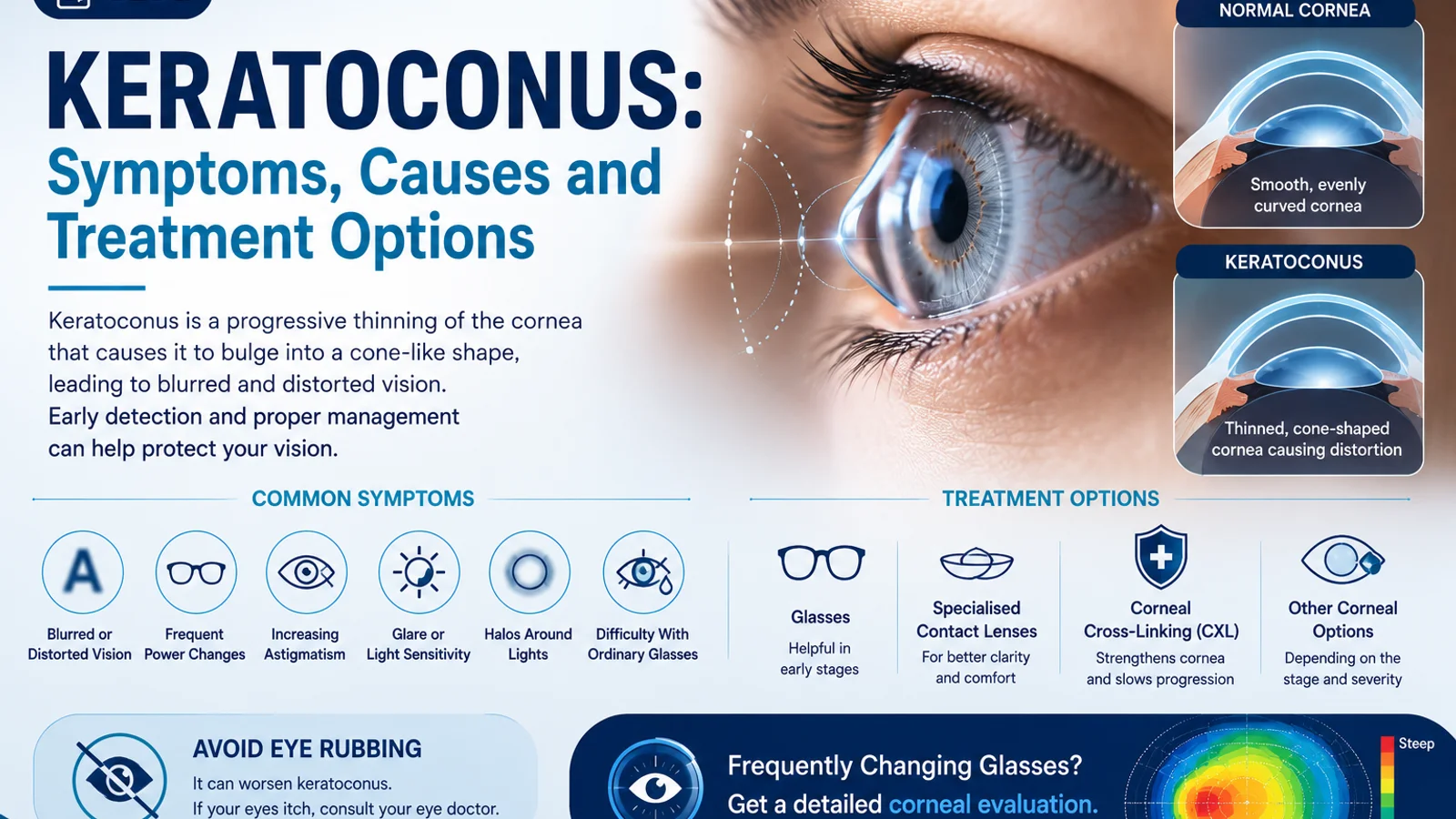
Keratoconus is a progressive eye condition in which the cornea becomes thinner and gradually develops a cone-like shape.
Because the cornea plays an important role in focusing light, this irregular shape can cause blurred and distorted vision.
What Treatment Options Are Available?
- 1Glasses
Spectacles may provide useful correction during earlier stages.
- 2Specialised Contact Lenses
Gas-permeable or scleral lenses can be considered to improve visual quality when an irregular corneal surface makes ordinary spectacle correction less effective.
- 3Corneal Cross-Linking
Corneal cross-linking, commonly called CXL, is intended to strengthen corneal tissue and help stop or slow progression in appropriate patients. It is primarily a progression-control procedure rather than simply a way of removing spectacle power.
- 4Other Corneal Options
Additional management may be considered depending on the severity and characteristics of the condition.
Why Is Early Detection Important?
Keratoconus can progress over time, particularly in younger patients.
Corneal measurements allow the ophthalmologist to monitor whether its shape or thickness is changing.
Detecting progression early can influence decisions about treatment.
How Is Keratoconus Evaluated?
Assessment may include detailed examination and corneal imaging.
Corneal topography maps the shape of the cornea and can help identify and monitor irregularities.
Other measurements may be used to assess corneal thickness and structural changes.
What Are the Common Symptoms?

Increasingly blurred or distorted vision
Vision may become progressively blurry or distorted as the cornea changes shape.

Frequent spectacle-power changes
Repeated changes in your glasses prescription may indicate progressive changes in the cornea.

Increasing astigmatism
Astigmatism may worsen over time, leading to more distorted and unclear vision.

Glare or sensitivity to light
Bright lights may cause discomfort and make it harder to see clearly.

Halos around lights
You may notice glowing rings or halos around headlights and other bright light sources.

Difficulty achieving clear vision with ordinary glasses
Even with updated spectacles, vision may remain unclear due to the irregular shape of the cornea.
One Important Habit: Avoid Eye Rubbing
People with keratoconus are generally advised to avoid persistent eye rubbing.
If your eyes frequently itch, discuss the underlying cause with your eye doctor rather than repeatedly rubbing them.
“Dr. Amit Solanki has been dedicated to the field of ophthalmology since 2003, amassing over 20 years of invaluable experience. He embarked on his journey by completing his undergraduate training (MBBS) followed by further postgraduate studies (MS) at the esteemed B.J. Medical College in Ahmedabad, Gujarat.”

The information is for educational purposes and does not replace professional medical advice, diagnosis or treatment.
Was this article helpful?
Subscribe to Newsletter
Get health tips.